

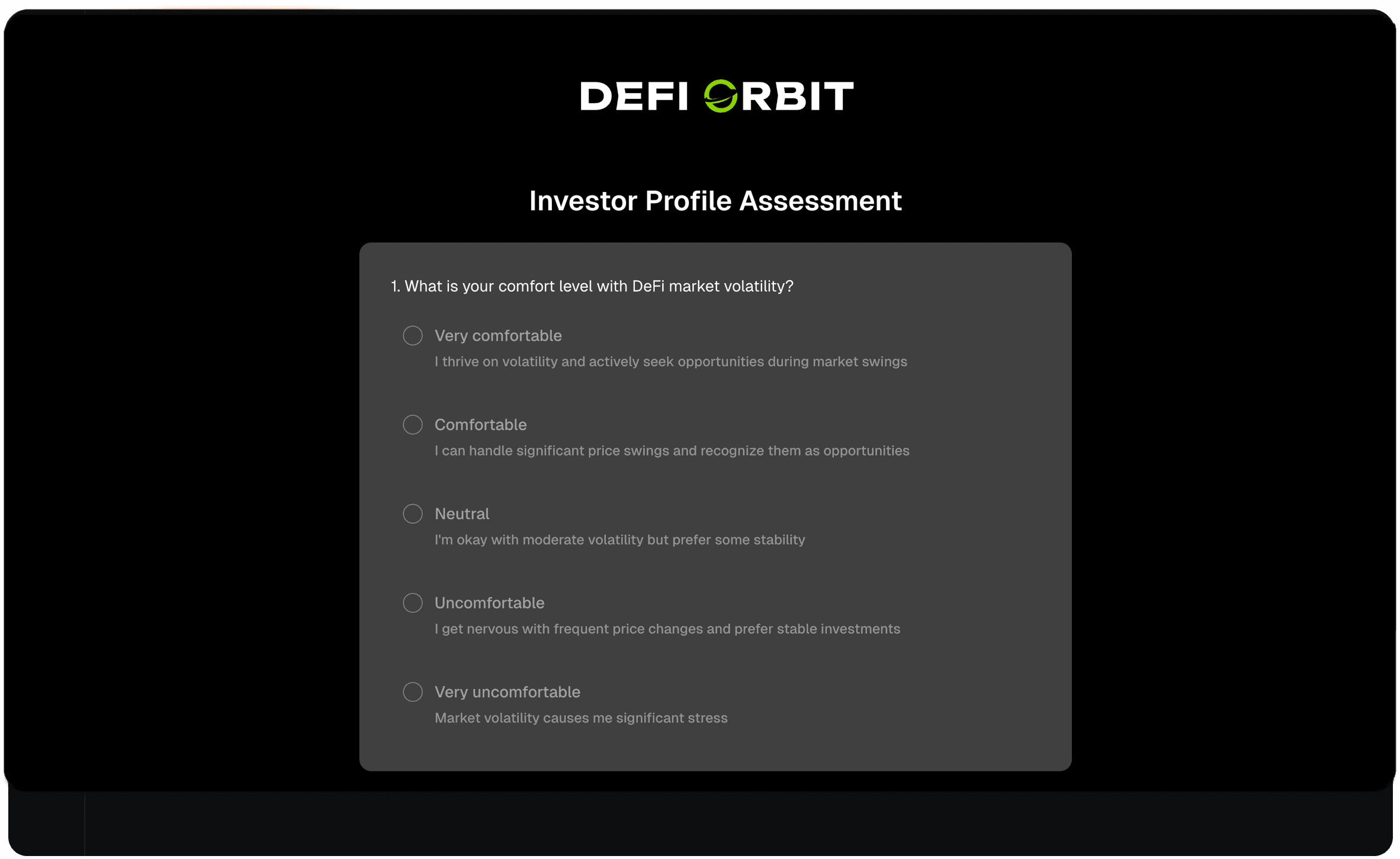
What is the Risk Assessment?
The Risk Assessment is a short questionnaire—9 questions about your comfort with volatility, investment horizon, DeFi knowledge, risk tolerance, diversification, protocol selection, management frequency, income priority, and liquidity needs—that helps you understand whether your current portfolio aligns with your risk tolerance, investment goals, and management style. Based on your answers, you’ll receive one of three risk profiles:How to Take the Assessment
- Navigate to Investor Profile in the main menu
- Find the Risk Assessment section
- Click Take Assessment (first time) or Retake Assessment (if updating)
- Answer the questionnaire honestly based on your actual investing behavior
- Review your results and click Submit to save them
What You’ll See After the Assessment
Once you complete the questionnaire, your results page displays: Your Score Your total points out of 90. Your Risk Profile Type All three investor categories are shown with their score ranges and descriptions, with yours highlighted—so you can see how close you are to the neighboring profiles. On Your Investor Profile Page After submitting, your Investor Profile page shows your score, your profile category, and the strategy approach recommended for your investing style (position range preferences, review frequency, chain and fee tier selection).The Three Risk Profiles
Aggressive DeFi Investor (Score: 0-27)
Characteristics:- Comfortable with high-risk, high-return strategies
- Actively manages concentrated liquidity positions
- Willing to explore newer protocols and innovations
- Primary goal: capital appreciation
- Frequent portfolio rebalancing (daily or multiple times weekly)
- 25-30% Core holdings (blue-chip assets in active LP positions)
- 40-50% Growth opportunities (narrow range concentrated liquidity)
- 15-20% Experimental strategies (newer protocols)
- 5-10% Stablecoins (for quick entry into opportunities)
Moderate DeFi Investor (Score: 28-54)
Characteristics:- Balances growth with stability
- Mix of concentrated and wider-range positions
- Regular monitoring with less frequent adjustments
- Combines established protocols with select new opportunities
- Weekly position reviews with occasional adjustments
- 40-50% Core holdings (established assets, medium-range positions)
- 20-30% Growth component (selected concentrated liquidity)
- 15-20% Yield generation (lending on established platforms)
- 10-15% Stablecoins (for opportunities and adjustments)
Conservative DeFi Investor (Score: 55-90)
Characteristics:- Prioritizes capital preservation and steady income
- Focus on lending and wider-range liquidity positions
- Less frequent position adjustments (bi-weekly or monthly)
- Primarily uses well-established protocols
- Primary goal: income generation and stability
- 50-60% Core holdings (blue-chip assets, wide-range LP positions)
- 25-30% Income generation (lending on established platforms)
- 15-20% Stablecoins (capital preservation and flexibility)
- 0-5% Limited growth (optional small allocation)